ChatGPT Prompts for Email Marketing: The Complete Playbook That Actually Works


As an email marketer, you must have experienced that or seen other marketers fail with that. Just suppose you open ChatGPT. You type “write me a marketing email.” The result is robotic email content that doesn’t feel human at all. You close the tab, write your mail manually, and conclude that AI isn’t helpful.
But the issue isn’t with ChatGPT. The problem is that the prompt isn’t right. And the result isn’t wrong due to the lack of capability in an AI tool. It’s just that you need to work on the way you ask what you need and explain it.
Considering that, always remember that an AI tool can give you proper campaign-ready drafts if you provide the right ChatGPT prompts for email marketing. With that, you can make your AI tool an assistant for content marketing.
Our guide helps you with that. In it, we explain how to build prompts that actually work, and provide you with ready-to-use prompts for ChatGPT. We have organized these prompts by campaign type and use case, including cold outreach, list-sourced lead generation, deliverability-aware writing, and prompts built specifically for SMS and phone-based multichannel sequences.
Want to know how to excel? Let’s discover.
The CRAFT Framework: How to Build ChatGPT Email Prompts That Deliver
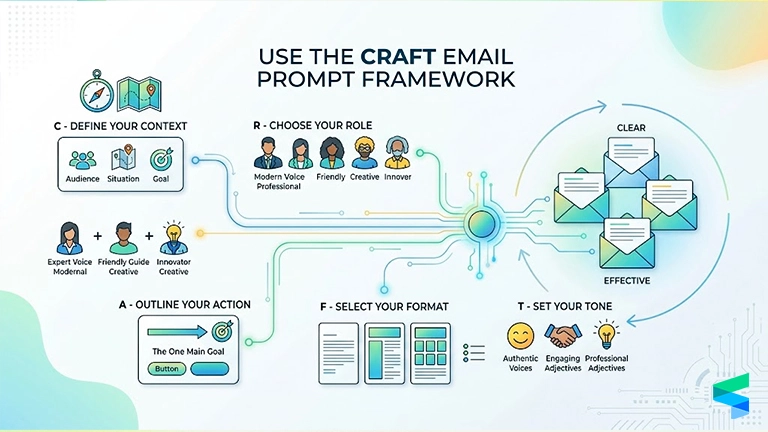
All the email marketing prompts for ChatGPT rely on five elements that build a complete structure. It’s called CRAFT. It applies to every email type, every audience, and every campaign goal.
So, let’s discuss these five structural elements in detail:
- C – Context: Clearly explain who you’re writing for, as it helps the AI tool better understand your business needs. Define your:
- Audience
- Industry
- Product or service
- Source of your target list
- Target market or location
- R – Role: Guide ChatGPT to adopt the tone and style of the persona you want it to be.
- Example: “You are a B2B cold email specialist with 10 years of experience in outbound lead generation.” It helps the tool to understand the role and craft the perfect content for your cold email campaigns.
- A – Action: Just a “write an email” isn’t enough. Clearly explain your required action and result. For example, you can guide it to write a cold email with:
- 150-word content
- 50-character subject line
- CTA for a 15-minute call
- F – Format: Specify structure. Explain it, whether you want to:
- Create a numbered list of subject line options
- Separately label subject line, preview text, body, and CTA
- Write it in three variations
- T – Tone: Decide the tone for your email. It can be:
- Authoritative
- Empathetic
- Friendly
- Urgent
Then, add guidelines. These can be: - No words that trigger spam trigger words
- No exclamation points
- No passive voice
- Word count limit (e.g., maximum 150 words)
- No specific revenue claims
When you run every prompt through CRAFT before submitting it, it increases the quality of your first draft, and it also saves you the time spent on editing.
Top ChatGPT Prompts for Email Marketing
Here are the best ChatGPT marketing prompts for your campaigns.
Category 1: Cold Email Outreach Prompts
Cold outreach campaigns succeed when you reach out to relevant email addresses through high-quality copies. If you source a verified and targeted B2B email list, your prompt should be specific to your target leads.
Prompt 1 — Core B2B cold email:
“You’ve spent years writing cold emails, and you know what actually works. Now write one targeting operations directors at mid-size manufacturing companies. My company makes project management software for teams that are tired of chasing updates across spreadsheets and manual trackers just to keep production on schedule.
Get right to the point. Talk about real issues, such as:
- Missed deadlines
- Scattered tracking systems
- Daily stress while trying to manage everything manually
Make sure to keep:
- Subject line with a maximum of 48 characters
- Email no longer than 140 words
End the email. See if they’re free to talk for ten minutes. Ask for the best day and time. No exclamation marks. No corporate fluff.”
Prompt 2 — B2C product announcement cold email:
“Write a cold email to consumers who have shown interest in home fitness but never purchased from us. My brand sells compact resistance training equipment for small apartments.
Make it sound natural, enthusiastic, friendly, and relaxed. Write as someone who casually shares advice after a workout.
Subject line under 50 characters. Body at a maximum of 150 words.
CTA: Buy our starter kit at first-order discount. Don’t use ‘free’ in the subject line.
Prompt 3 — B2C re-engagement after website visit:
“Write a cold re-engagement email targeting consumers. They browsed our online skincare store but didn’t buy products. The email should feel personal and low-pressure. Acknowledge that they were looking at something specific (use [Product Category] as a placeholder). Remind them what makes the product different in two sentences. End with a soft CTA — no hard sell. Under 130 words.”
Category 2: Subject Line Generation Prompts
Prompt 4 — Bulk subject line generation for B2B:
“Write 15 cold email subject lines aimed at marketing directors at e-commerce brands promoting an AI ad optimization platform.
Use a mix of tones and formats:
- 3 curiosity-driven
- 3 focused on clear outcomes or wins
- 3 written as questions
- 3 hinting at popularity or market momentum
- 3 ultra-short options under 30 characters
Keep every subject line under 55 characters, natural-sounding, and varied in style. Flag any that risk spam filter triggers with a brief note.”
Prompt 5 — Bulk subject line generation for B2C:
“Create 12 email subject lines for a promotional campaign for a travel deals newsletter subscribers. Announce a flash sale on European vacation packages.
Include:
- 3 urgency-focused subject lines
- 3 curiosity-led subject lines
- 3 benefit-oriented subject lines
- 3 written as questions
Requirements:
- Subject line: Max. 50 characters
- Don’t use: “free,” “guaranteed,” or “winner.”
- Make them feel natural, catchy, and email-friendly.”
Prompt 6 — A/B subject line pairs:
“Write three matched A/B subject line pairs for a cold outreach email targeting HR directors about an employee wellness platform.
For each pair: Version A uses urgency or a pain point, Version B uses curiosity or a surprising angle. Label each pair clearly and note in one sentence which audience mindset each version speaks to.”
Prompt 7 — Re-engagement subject lines:
“Write 10 subject lines. Target subscribers who haven’t opened emails for over 90 days.
Write for an online learning platform that focuses on helping people build career skills.
Tone: Reach out as a friend you haven’t met for some time.
The subject lines should be simple and natural in the inbox. Don’t use promotional words. Include at least two subject lines that directly acknowledge the subscriber’s absence without being cringey.”
Category 3: Email Sequence Prompts
Using AI in sequence emails can help you deliver quick results. Instead of writing four to five emails one by one, a proper single prompt can prepare a complete series of emails for you.
Prompt 8 — B2C welcome and nurture sequence:
“Create a 4-part email sequence. Write emails for a new subscriber. They signed up for a beauty brand newsletter via a pop-up, which offers a 10% off their first order.
- Email 1: Deliver the:
- Discount code
- Brand introduction
- One line about what to expect
- Email 2 (Day 2): highlight a best-selling product and personally recommend it to the prospect
- Email 3 (Day 5): present social proof via:
- Customer results
- Reviews
- Before-and-after framing
- Email 4 (Day 9): give a light reminder to the prospect if they haven’t used the discount. Also, give a soft reminder that it’s set to expire.
In every email, add a:
- Subject line
- Body under 160 words
- One CTA.”
Prompt 9 — Cold-to-warm B2B conversion sequence:
“Write a 3-email sequence to move a cold B2B contact from first awareness to a booked discovery call. I sell a cloud-based accounting tool for professional services firms.
Email 1: Identify the problem — manual reporting eating into hours that should be billable. No product mentioned yet. Just make the problem feel real.
Email 2: Paint a concrete picture of what their week looks like with automated reporting instead. Not a features list — a scenario they’d actually recognize.
Email 3: Ask directly for a 15-minute talk. Not a demo. Not a sales call. Just a conversation. Make that distinction clear in the copy.
Tone across all three: peer-level, confident, consultative. Each email under 160 words.”
Category 4: Welcome Emails
Prompt 10 — B2B Newsletter Welcome Email
“Write a welcome email for a new subscriber joining a B2B marketing newsletter covering growth strategy, demand generation, and content marketing for tech companies.
Don’t write this like a brand talking to someone. Write it as a knowledgeable peer, someone glad that they signed up. Tell them exactly what they’re getting:
- Topics
- Frequency
- Why it’s worth staying on the list
Don’t make any vague promises like “valuable insights” or “exclusive content.” Be specific. If they get one email a week with one actionable idea, say that.
Under 180 words. One soft CTA: explore the archive so they can see what they’re signing up for.”
Prompt 11 — Lead Magnet Delivery Email
“Write a welcome email that delivers a free guide called “The Cold Email Playbook: 7 Steps to a Consistent Pipeline.”
Start by confirming the download is right there — get that out of the way clearly in the first line. Then do something most brands skip: pull out two specific insights from the guide that tend to surprise people when they read them. Not vague teases — actual things that make them want to open the file today, not next week.
After that, briefly introduce who’s behind this resource. Not a company bio — just enough context to explain why you’re worth listening to on this topic.
Under 200 words. One CTA: download the guide.”
Category 5: Promotional Emails
Prompt 12 — B2B Limited-Time Offer Email
“Write a promotional email announcing a 30% discount on annual software subscriptions. This offer runs for 72 hours only.
We’ll target marketing managers at mid-size B2B companies currently on a monthly plan. These are busy, analytical people — don’t waste their time building up to the offer.
Lead with the savings, not the product. Add two bullet points explaining why annual beats monthly for their actual workflow — think budget predictability, fewer billing cycles, concrete time saved. Include a line that creates real urgency without being overdramatic. Suggest the button copy for the CTA.
Body under 180 words.”
Prompt 13 — B2C Flash Sale Email
“Write a flash sale email for a fashion e-commerce brand. The brand offers 40% off on products for 24 hours. This is going to existing subscribers who’ve bought from us before — they know the brand, so skip the lengthy intro.
Tone: excited, punchy, scannable.
Three bullet points that highlight the best categories on sale. It’s enough to spark interest. Place the CTA at the start and end of the email. With that, users can easily act without scrolling through the mail. Add a preview text suggestion to complement the subject line without repeating it.
Total body copy under 150 words.”
Prompt 14 — New Product Feature Launch Email (Existing Customers)
“Write an email announcing a new analytics dashboard feature added to an existing project management platform.
This is going to current paying customers — people who use the product every day. Don’t write it like a product launch ad. Write it like an insider update. So, they find it useful.
Tell them the product features and benefits in one sentence. Explain how it solves problems in two sentences. Then add one CTA: explore the new dashboard.
Under 170 words. No overselling. They already bought.”
Category 6: Deliverability
Prompt 15 — Spam-Trigger Audit and Full Rewrite
“I need you to put on two hats for this one.
First, go through the email below. Flag anything that triggers spam filters:
- Specific words
- Phrases
- Structural patterns
- Formatting habits that email providers flag
Explain each issue with risks and suggest safer and better options.
Then, once the audit is done, write a complete, clean version of the email. Keep every bit of its persuasive intent, offer, and urgency. Just get it past filters without gutting what makes it work.
[Paste your email here].”
Prompt 16 — Preview Text Optimization
Write 5 preview text options to pair with this subject line: “[First Name], your October exclusive is inside.”
Each preview text should do a different job — complement the subject line without repeating it, stay under 90 characters, and give someone a genuine reason to open before they’ve clicked.
Label each one by the technique you’re using:
– Curiosity
– Direct benefit
– Social proof
– Urgency
– Personalization
The goal is for each option to feel like it belongs to a completely different email, based on the preview alone.”
Category 7: Segmentation & Personalization
Prompt 17 — Three-Segment Email Variation (B2B)
“Write three versions of the same cold outreach email for a cybersecurity awareness training platform. Same product, same goal — three completely different emails based on who’s reading.
Version 1 goes to IT managers at financial services firms. Their world is regulatory compliance. That’s the lens through which they evaluate everything.
Version 2 goes to HR directors at healthcare companies. Their concern is employee behavior — specifically, who’s clicking phishing links and how to change that before an incident happens.
Version 3 goes to operations managers at logistics companies. Their fear is downtime. A ransomware attack doesn’t just cost money — it stops trucks.
For each version, adjust the pain point, the language, and the specific supporting detail. Don’t just swap one line — actually rewrite for each person. Subject line, body under 150 words, one CTA per version.”
Prompt 18 — Dynamic Content Block — New vs. Returning Customers
“Write two versions of a single email paragraph to be used as a dynamic content block in a promotional campaign.
Block A is for first-time visitors who’ve never purchased. They don’t know us yet. Use discovery and curiosity — make them interested, not pressured.
Block B is for returning customers on their second or third order. They already trust us. Use loyalty and recognition — make them feel seen, not sold to.
Both blocks promote the same premium product upgrade. Keep each block under 80 words. The tone and framing should feel completely different, even though the offer is identical.”
Category 8: Newsletter and Educational
Prompt 19 — Educational Newsletter Section
“Write a 280-word newsletter section on improving cold email reply rates in 2025. The tone should feel like an experienced practitioner sharing direct observations — not a blog post pulling from general best practices.
Don’t give vague advice like “personalize your emails.” Everyone says that. Give me one specific technique that genuinely works right now, one common mistake most email marketers are still making without realizing it, and end with a teaser question that previews next week’s topic without giving it away.
Write it like someone who’s actually sent a lot of cold emails — not someone who’s read about it.”
Prompt 20 — Opinion-Led Newsletter Piece
“Write a 300-word newsletter piece with an unusual opinion: ‘Why email open rates are an important metric — and what to track instead.”
The tone should be confident and evidence-referenced, but conversational — not a lecture. Acknowledge why most marketers still chase open rates (the data is easy, the reporting looks good). Then pivot to a practical argument for three better metrics: reply rate, click-to-conversion, and pipeline contribution.
Be specific. Use real reasoning, not just assertions. The reader should finish this piece. They should gain insights that they could actually bring up in a meeting.
Audience:
B2B email marketers
Demand gen professionals.”
Category 9: Editing & Improvement
Prompt 21 — Cut and Sharpen — Reduce by 40%
“Take the email below and reduce it by 40%. Don’t just trim random sentences. Make every remaining word earn its place.
Here’s what to prioritize:
- Shorter sentences. If a sentence can be split, split it.
- Active voice. Passive voice is where all the extra words hide.
- One idea per paragraph — not two, not three.
Add a final CTA that instructs them what to do and why right now.
Nothing persuasive gets cut. No key information disappears. This is about removing the fat, not the muscle.
[Paste your email here].”
Prompt 22 — CTA Strengthening — Four Angles
“The call to action I’ve been using is too weak: ‘Click Here to Learn More.” This email goes to marketing operations managers and promotes a B2B SaaS product.
Write four replacement CTAs using four completely different psychological angles:
(1) Urgency: something has to happen now
(2) Curiosity: they need to find out something
(3) Direct benefit: one clear thing they get by clicking
(4) Low-commitment: users feel easy to take the first step
Give me the CTA text for each one. Also, add a one-line reason that explains why it should outperform “Click Here to Learn More” for this specific audience. ”
Category 10: Objection Handling
Prompt 23 — Handling the “Too Expensive” Objection
“Write a follow-up email for a B2B prospect who replied to a cold email saying the price is too high.
Don’t apologize. Don’t immediately slash the price — that just tells them the first number was made up. Instead, do three things:
- First, acknowledge the concern like a real person would — respectfully, without being defensive.
- Second, break down what the investment actually covers in concrete terms. What do they get with the price that they may not notice at first?
- Third, give them an easier way to get started, such as a:
- Gradual rollout
- Starter plan
- Trial
So, they can try it without making a big commitment right away. That makes it easy to move forward without committing to everything up front.
Tone: confident, friendly. Under 160 words. One CTA: a 15-minute call to find what actually fits their budget.”
Building a Prompt Library: The System That Saves Hours Every Week
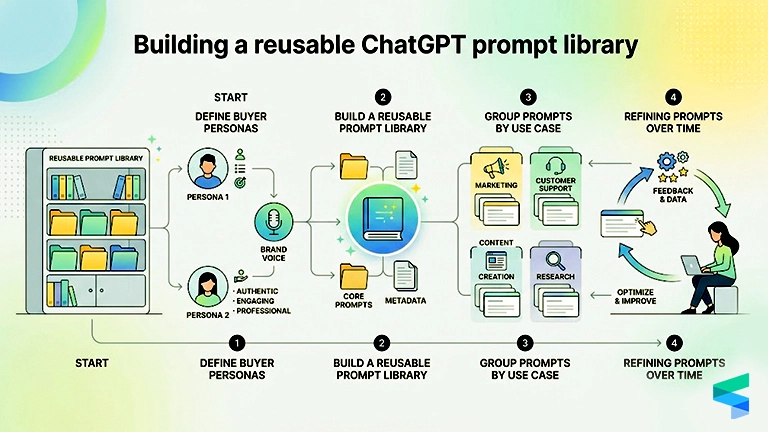
Knowing how to use ChatGPT for marketing professionally isn’t just about writing good prompts. You must build a proper library of prompts that can be:
- Refined over time
- Organized by use case
- Shared across the team
Here is how to structure one:
Create a Master Prompt File
Use a shared document or a Notion page to organize prompts. And group your prompts by category, such as:
- Cold outreach
- Subject lines
- Email sequences
- Promotional emails
- Newsletters
- Rewriting
- A/B Testing
With that, they’re easy to find and use.
Document Successful Prompts
When a prompt produces a strong output, save both the prompt and the output together. Note what specifically made the prompt effective.
Build Buyer Persona Briefs
For each major audience segment you target, write a one-paragraph persona brief that you paste into prompts as context. This is your single biggest quality lever.
Create Brand Voice Guidelines
Write a 150-word description of your:
- Brand voice
- Common phrases to use
- Examples of on-brand copy
- Phrases to avoid
Paste this into any prompt where tone matters.
Review Prompts Every Week
Each week:
- Review outputs
- Refine the prompts that underperformed
- Archive the prompts that consistently deliver
By doing so, your prompt library compounds in value over time, exactly like your list.
What ChatGPT Cannot Do and Where You Fit In?
ChatGPT is useful. But it doesn’t think like a person.
A chatbot can’t:
- Know your target audience
- Track analytics from your previous campaign
- Know which subject lines your email list has seen
- Find offers that you’ve already presented
- Recall the previous week’s sent emails
- Confirm that emails are CAN-SPAM or GDPR-compliant
And the AI result is not final. Humans need to review it, which proves the fact that AI doesn’t replace professionals. It just helps them perform fast and make smarter decisions.
The List Quality Multiplier
Every prompt in this guide works if your email is sent to a relevant and verified contact. But if the best cold email is sent to an unverified list, it delivers poor results. It also damages your sender reputation and potentially your domain.
However, it can be avoided, and lead generation professionals can succeed if they understand the rule: prompt quality improves email copy, but list quality sets the foundation.
With that, you need segmented and refreshed contact data for email, phone, or SMS. It helps transform AI-assisted copy into measurable campaign results.
As a result, the right data helps your ChatGPT prompts for marketing work better, and the results speak for themselves.